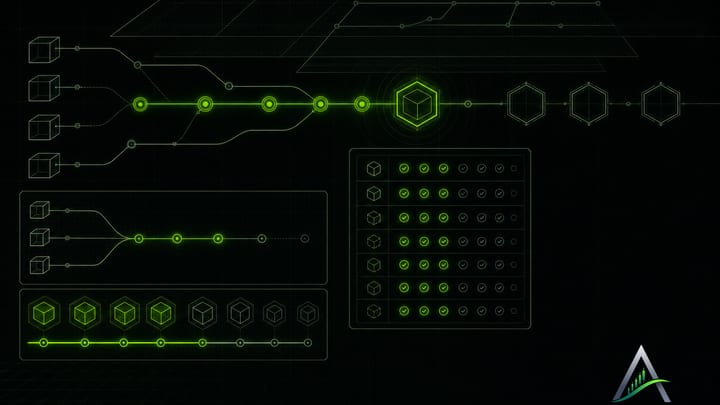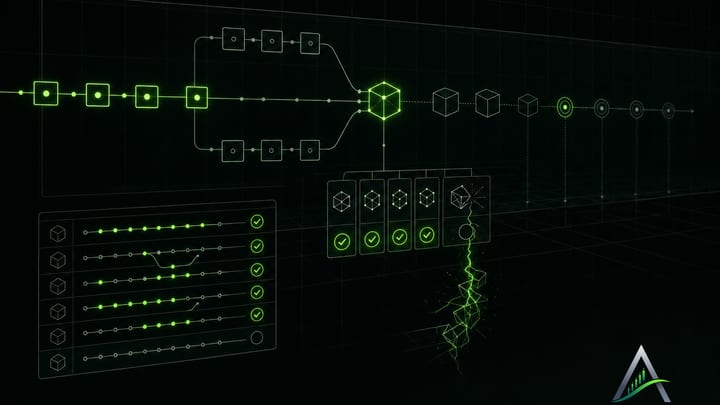
There is a word we are careful with on Atheron Progress. The word is shipped. It is easy to say and easy to misuse, so we gave it one meaning and we hold to it.
Shipped means somebody uses it today.
Not finished. Not merged. Not demoed. Used, by a real person, now. If nobody uses it, it is not shipped, however much work went into it.
Why finished is not enough
Most software has a stage where the code is done and the feature still has no users. The tests pass. The branch is merged. Everyone involved is tired of it. It would be comfortable to call that shipped.
We do not, for a plain reason. A tracker that counts finished code tells you how busy we have been. A tracker that counts used code tells you what exists. You are reading Atheron Progress to learn the second thing, so that is what we count.
The gap between the two is where projects quietly go wrong. Code that is done but unused can sit for months. If we marked it shipped, the percentage would rise, the page would look healthy, and nothing would have changed for anyone outside the company. The number would be true in a narrow sense and misleading in every sense that matters.
The four marks
Every project on the tracker is split into modules, and every module carries exactly one mark.
| Mark | What it means |
|---|---|
| Shipped | Somebody uses it today |
| Building | Work is under way, nobody uses it yet |
| Next | Queued to be built after what is building |
| Later | Known, wanted, not scheduled |
Only the first mark counts towards a project's percentage. The other three describe intent and effort, which are worth showing but are not progress in the sense the page measures.
The percentage is counted, never typed
Nobody at Atheron types a number into the progress page. The percentage for each project is counted from the marks on its modules, and the marks are computed from our repositories. If we want a number to move, the only way is to change what the code does and who uses it.
This matters because a typed number invites rounding up. A counted number does not care how we feel about the week. It goes up when a module becomes shipped and it goes down if a module stops being shipped. Both directions are allowed. A module that loses its users loses its mark.
What this looks like on the current projects
The rule applies the same way to every project, and it produces some results that look strict.
Atheron Trading runs on paper only until launch. Paper trading is a real activity, and modules that people use for it can be marked shipped. We publish no performance figures from it, because paper results are not the same as live results and we do not want the two confused.
ATON Desk is marked coming soon. A project that is coming soon has, by definition, nothing anyone uses today, so its shipped count reflects that. We would rather show a low number that is honest than a high number that is anticipation.
Atheron Network Labs is open for projects. The modules there follow the same test: used today, or not shipped.
ATON Blockchain sits under the same rule. What the tracker says is what we are willing to stand behind.
The honest limits of this definition
The rule is clear, but it is not perfect, and you should know where it bends.
- Somebody can be a small number. One real user is enough. We do not publish user counts on the tracker, so shipped tells you a module is in use, not how widely.
- Today is checked when we review the marks, not continuously. A module could lose its users between reviews and still show as shipped until we next look.
- A module can be shipped and still have bugs. Shipped means used, not flawless. The status page, with its ninety days of history, is the place to see whether a public service is actually up.
We would rather state these limits than let the word carry more weight than it can hold.
How to read the page with this in mind
When you look at a project, read the marks before the percentage. The percentage is a summary. The marks are the record. A project at a low percentage with several modules building is in a very different place from a project at the same percentage with everything marked later.
Then check the changelog and the roadmap. The changelog records what changed and when. The roadmap records what we intend. Between them and the marks, you can see whether a module that was building last fortnight is shipped this fortnight, and if it is not, you can see why.
That is the whole system. One strict word, counted rather than typed, with the record beside it so you can check our work.